A Book That Got Someone Through the Dark
My uncle once told me that during the lowest point of his life, one book kept him going through his darkest days.
It was called The Ordinary World (平凡的世界), by Lu Yao.
He wasn’t giving me a casual recommendation. You could tell he was talking about something that genuinely mattered to him. So I took it seriously and started digging into the book — reading excerpts, reviews, and the famous quotes that people love to share online.
And honestly? A lot of those lines hit hard:
“Life can’t wait for someone else to arrange it for you. You have to go out and fight for it yourself. Win or lose, at least you can say you didn’t waste your time on this earth.”
“Even without the moon, the heart can still be full of light.”
“The strength of a life grows in the crucible of suffering.”
There’s warmth in these words. Real warmth. The kind that makes your chest tighten a little and think, yeah, I should take my life more seriously.
But then I tried to push one layer deeper. And I got stuck.
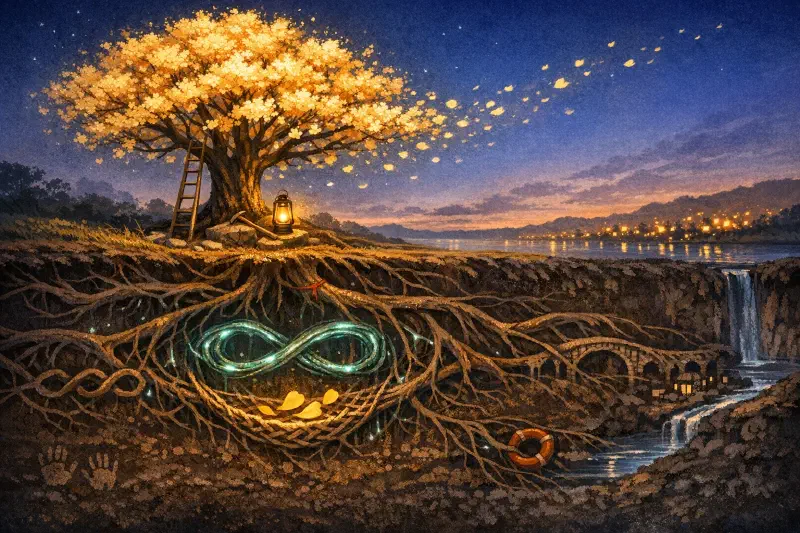
A Tree in Full Bloom — With No Roots
My question was simple: Why?
Why should we fight? Why is suffering supposed to be meaningful? Why is “living seriously” better than not?
The book’s answers almost always live on the emotional level: because you deserve dignity, because you shouldn’t give up, because labor is fulfilling, because the inner life matters more than material wealth.
These sound right. But if you keep pressing — why does the inner life matter more? Who decided dignity is non-negotiable? What happens if I choose to give up? — you’ll find that these answers have no roots.
It’s like a tree in full bloom. Lush, beautiful, moving. But look underneath and there’s no root system holding it up. The flowers are real. The emotion is real. But the logical foundation beneath it all is simply missing.
This isn’t me saying the book is bad. Quite the opposite — it did something genuinely important: it gave countless ordinary people, struggling in difficult circumstances, a form of spiritual sustenance.
But comfort and understanding are two different things. Painkillers ease the ache, but they don’t tell you where the pain is coming from.
Emotion Is a Double-Edged Sword
Here’s something we have to confront head-on: emotion, by itself, has no direction.
Being moved by an idea doesn’t mean the idea is right.
This isn’t abstract philosophizing. History’s most extreme movements — East and West alike — were almost always overflowing with passion, conviction, and genuine emotion. Many of the people involved sincerely believed they were doing the right thing. Some sacrificed everything for their cause. But the outcomes?
Emotion can drive a person to read books by dim lamplight after a brutal day in the coal mines. It can also drive someone to cut corners on food safety because they’re “providing for their family.” Both are “working hard.” Both are “hustling.” Both feel meaningful to the person doing them.
If our framework for meaning stops at “I feel like this is the right way to live,” then it can’t tell these two people apart.
So the real question isn’t whether we need a sense of meaning — of course we do. The question is: what kind of meaning can actually withstand scrutiny?
Three Characters, Three Half-Finished Answers
Let’s go back to the novel’s three central figures and see what each one offers.
Sun Shaoping: The Individual Who Reaches Upward
He does the hardest labor in the coal mines, then comes home and reads by dim light. His body is at the bottom of society, but his spirit keeps reaching upward.
He represents the force of “I refuse to be defined by my circumstances.”
It’s compelling. But here’s the problem: where does that upward drive point? What if someone’s “refusal to settle” leads them in the wrong direction? What if their “spiritual pursuit” happens to cause harm?
Sun Shaoping earns our admiration because he happened to choose reading, reflection, and kindness. But the book never explains: why is his choice right and another choice wrong?
Sun Shao’an: The One Who Carries Everything
He barely has a self. Dropped out of school, farmed, ran a brick kiln, supported his entire family. His life is crushed under the weight of two words: responsibility.
He represents “I don’t get to think about myself. I just carry.”
This is the most honest portrait of how many ordinary people actually live. But the same problem surfaces: a sense of duty doesn’t come with built-in moral guardrails. A person can shoulder responsibility to feed their family, or shoulder responsibility to do the exact opposite — as long as they believe it’s “for the people I love.”
Tian Xiaoxia: The Idealist Who Burns for Her Beliefs
She’s the brightest person in the book. Privileged background, talented, idealistic. She falls in love with a coal miner, unbothered by the class divide. She dies saving someone during a flood while reporting on the front lines.
She represents “I’m willing to give everything for what I believe in.”
But this is also the most dangerous pattern — what if the belief itself is wrong?
History is full of people who died for their convictions, and their convictions didn’t always deserve that sacrifice. Tian Xiaoxia breaks our hearts rather than frightening us because her beliefs happened to point toward goodness and justice. But the book never answers: how do you judge whether a belief is worth dying for?
The Missing Layer: From “I Feel” to “Why Should I”
Three characters, three kinds of strength, three incomplete answers.
Their shared problem: they all stay inside the individual’s emotional world and never connect to a larger system.
“I choose to grow” — great, but why? “I choose to carry the burden” — great, but where’s the boundary? “I choose to die for my belief” — great, but who decides the belief is sound?
If the final answer to all of these is “because I feel like I should,” then we’re stuck in a loop: the only basis for meaning is my own feelings.
And feelings, as we’ve just discussed, are unreliable.
A Moral Foundation That Doesn’t Need God
So in a cultural context without an absolute authority — without a religious tradition that hands down morality from above — can we actually find something more solid?
I think we can. And the direction is surprisingly simple.
Let’s start with the most basic fact: nobody wants to die.
Steve Jobs put it bluntly: no one wants to die. Even people who want to go to heaven don’t want to die to get there.
This isn’t a philosophical proposition. It’s biological instinct. As long as humans are animals with a survival drive, this holds almost universally.
The reasoning that follows is natural:
If I don’t want to die, I need an environment that helps me stay alive and live well.
That environment is society.
A person alone in the wilderness can be eliminated by nature at any moment. But in a cooperative group, risk is shared, resources are pooled, and everyone’s odds of survival go way up.
Society isn’t a cage imposed on the individual — society is a structure that individuals naturally evolved because it helps them survive.
The Positive Feedback Loop: Individual and Society as Symbiosis
There’s a crucial dynamic relationship here:
Individual wellbeing drives support for society; social stability, in turn, increases individual wellbeing.
This is a positive feedback loop.
Think of it as a system continuously optimizing itself — the happier individuals are, the more they contribute to society; the more stable society becomes, the more room individuals have to pursue happiness.
And within this loop, certain rules naturally emerge. Not because they’re sacred, but because —
without them, the loop collapses.
“Do Not Do to Others What You Would Not Want Done to You” — Not a Moral Slogan, but a Minimum System Requirement
Confucius’s famous maxim is usually taught as a moral lesson. But look at it from a different angle and it’s actually a deeply engineering-minded principle:
In a system of interdependent individuals, if everyone does to others what they wouldn’t want done to themselves, the system crashes.
You don’t want to be deceived, so don’t deceive. You don’t want to be harmed, so don’t harm. Not because some god is watching — but because if everyone behaved that way, you couldn’t survive either.
That’s why trust, honesty, and not harming others aren’t “noble choices.” They’re baseline conditions for society’s continued existence.
They’re not cosmic truths. But under the premise that “humans need to coexist,” they’re nearly irreplaceable.
Protecting the Vulnerable Isn’t Charity — It’s System-Level Risk Hedging
Here’s a commonly misunderstood question: why should society spend resources protecting vulnerable people?
From a pure “efficiency” standpoint, it seems wasteful. But in practice, it’s one of the keys to keeping the entire system running.
Imagine a long-haul truck driver. If he knows that the moment he gets into an accident and becomes disabled, society offers him zero protection — is he going to give his all at work?
Probably not.
But if he knows there’s a safety net — that even in the worst-case scenario, he won’t be completely abandoned — he can commit to his work more fully, take reasonable risks, and create more value.
Protecting the vulnerable is fundamentally a system-level signal: this is the kind of society we are.
The effect of that signal: it lowers fear for every participant, which raises the vitality of the entire system.
It’s a self-fulfilling prophecy. When a society declares “we protect everyone,” people are more willing to go all in for that society. Flip it around: if a society discards anyone who isn’t “optimal,” no one will truly trust the system, and no one will fight for it.
Rights and Obligations: The Invisible Contract Between Generations
There’s another layer that often gets overlooked: our relationship with those who came before us.
The clothes you buy for a few dollars, the phone that’s more powerful than a supercomputer from twenty years ago, the antibiotics when you’re sick, the roads and railways when you travel — none of this fell from the sky.
It was built up, piece by piece, by countless people before you — people who endured pain, failure, and even death that you can barely imagine.
People before the agricultural revolution suffered hardships far beyond anything we experience. Workers during industrialization, ordinary people during wars, survivors of plagues — their suffering and persistence, stacked together, produced what you casually call “everyday life.”
You are not an isolated individual. You are one link in a very long chain.
You inherited an enormous legacy from those before you — not just material, but knowledge, institutions, culture. And that inheritance naturally carries an implicit obligation:
You have a responsibility to leave the world at least no worse than you found it. And if possible, a little better.
This isn’t moral blackmail. It’s a straightforward reciprocity: you benefited from what previous generations built; future generations deserve to benefit from yours.
Back to The Ordinary World: Which Half Did It Complete?
Now we can evaluate the book more fairly.
What it accomplished matters enormously:
It gave countless people struggling in hardship a kind of strength — a sense that “I may be ordinary, but I am not mediocre.”
In environments where many people feel they don’t deserve dignity, that kind of strength can be lifesaving. My uncle said it carried him through his darkest days, and I fully believe him.
Those lines — “you can be ordinary, but you must have dignity, persistence, and direction” — for someone who is suffering, they’re like a match struck in the dark. Small, but enough to see the path at your feet.
But a match only lights so far.
It tells you “keep going,” but doesn’t answer “what’s worth persisting for.” It tells you “have dignity,” but doesn’t explain “where dignity’s boundaries are.” It tells you “fight,” but doesn’t distinguish “what kind of fighting is legitimate.”
Put more formally: it provides the motivation to survive, but not the constraints on behavior.
Literature and Philosophy: Two Roles, Neither Optional
This isn’t a “failure” of The Ordinary World. It’s the natural division of labor between literature and philosophy.
Literature’s power lies in empathy. It shows you a miner reading by dim lamplight and your chest tightens. It shows you Tian Xiaoxia disappearing into floodwaters and your eyes burn. It changes how you feel.
Philosophy’s power lies in argument. It doesn’t care whether you’re moved. It cares whether the logic holds, whether it scales to everyone, whether it breaks under extreme conditions.
A healthy value system needs both:
- Literature gives you courage — the will to keep living
- Philosophy gives you direction — the knowledge of what’s worth living for
Literature without philosophy becomes “passion without direction” — you’re deeply moved, but you don’t know which way to walk.
Philosophy without literature becomes “correctness without warmth” — you know what’s right, but you can’t summon the energy to do it.
“Seek Virtue and Find Virtue” — But Virtue Needs a Foundation
Early on, a line from Confucius came to mind: “He sought virtue and found virtue — what is there to regret?”
I chose what I believed was right, and I got it. What’s there to complain about?
It’s a beautiful idea, and it genuinely captures the spiritual core of the book’s three characters. Sun Shaoping sought spiritual growth, Sun Shao’an sought family stability, Tian Xiaoxia sought ideals and love — each sought their version of virtue, each found it.
But the problem is: “virtue” itself needs a standard of judgment.
Without a standard, “seek virtue and find virtue” collapses into “whatever I choose to believe is fine” — which logically constrains no one.
Confucius himself faced this problem. His system is full of intuitive wisdom — “do not do to others what you would not want done to you,” “cultivate the self, regulate the family, govern the state, bring peace to the world” — but these are more like distilled experience than a rigorous system derived from first principles.
This doesn’t mean Confucius was wrong. On the contrary, his intuitions were astonishingly accurate. But intuitions need argumentation to support them, otherwise they remain a tacit agreement within one cultural context — move to a different context and they might not hold.
So Where Does the Meaning of Life Actually Lie?
If you ask me, here’s how I’d answer:
The meaning of life is neither an objective fact waiting to be discovered, nor a subjective feeling you can make up on a whim.
It exists within a specific structure:
- You don’t want to die — this is the starting point, a near-universal biological fact
- You need society to live well — a natural consequence of survival logic
- Society needs rules to sustain itself — trust, non-harm, cooperation aren’t moral decorations; they’re operating conditions
- You inherited enormously from those before you — so you naturally bear some responsibility to those who come after
- Within this structure, your choices — to grow, to shoulder responsibility, to contribute — take on meaning that transcends the individual
This isn’t religion. It doesn’t need a god to endorse it. It’s not “just my feeling” either. It’s built on testable logic.
It’s a meaning rooted in symbiosis: your life has meaning not because you personally feel it does, but because you are part of a human community, and your existence and choices tangibly shape where that community goes.
Final Words
I don’t deny the value of The Ordinary World. For my uncle, for countless people who needed a spiritual anchor in hard times, its significance is real and deeply personal.
But I’m not satisfied with emotion alone.
For a tree to live long, beautiful blossoms aren’t enough — it needs roots.
And those roots aren’t found in any single novel, or in any one person’s feelings. They’re in the social structures we build together, depend on together, and pass down from generation to generation.
“Establish the heart of heaven and earth. Secure the livelihood of the people. Continue the learning of the sages. Open an era of peace for ten thousand generations.”
These four lines, written by an Eastern philosopher a thousand years ago, sound grand — heavy, even impractical.
But what they point toward is quite simple: you don’t live for yourself alone. You live for those who came before you, those who come after, and those who exist alongside you.
When you truly grasp this, “what’s the meaning of life” gains an answer that doesn’t lean on faith, doesn’t lean on emotion, but stands on solid enough ground.
Yet this answer is still incomplete. We’ve discussed the social foundations of meaning, but haven’t touched a deeper question: what are “meaning” and “value” as concepts? Are they objective features of reality, or cognitive tools that the human brain evolved? What happens when our capacity for logic becomes powerful enough to interrogate its own origins?
Those questions are for the next piece .
Disclaimer: Written by a human, with AI assistance in structuring and refining.