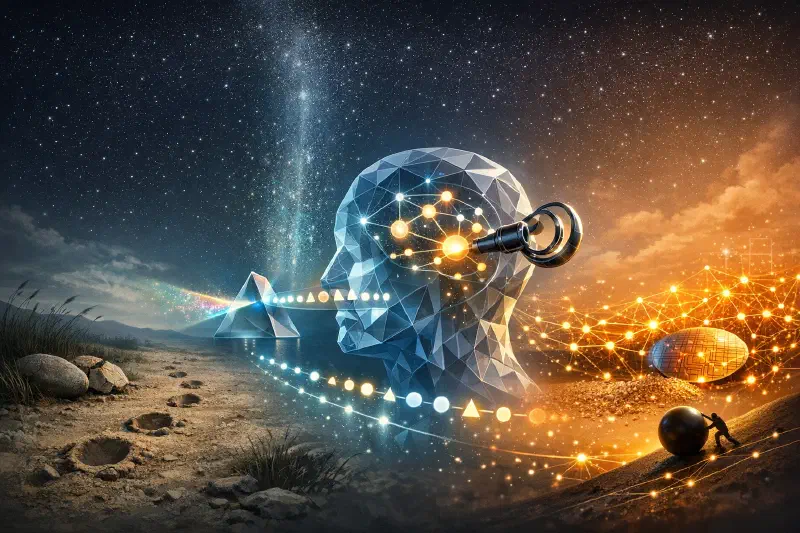
This is the sequel to When Hustle Loses Its ‘Why’ — The Ordinary World and the Crisis of Meaning . The previous piece explored the social foundations of meaning. This one digs a layer deeper and asks: where do “meaning” and “value” — the concepts themselves — actually come from?
A Question You’ve Probably Never Asked
We spend enormous energy debating whether life has meaning. But almost nobody stops to ask:
Where did “meaning” itself come from?
It’s like spending years arguing about whether a painting is beautiful, while never once wondering: who invented “beauty”? Why does the concept exist at all?
This isn’t a word game. When you actually trace where “meaning” and “value” originate as concepts, many of the philosophical puzzles that have haunted humanity for millennia suddenly become less mysterious — not because they get answered, but because you start to realize that some of them were badly formed questions to begin with.
Part One: Where Meaning Comes From
A Tiger, a Stone, and a Byproduct
Let’s start at the most primitive scene imaginable.
Deep prehistory. An early human is walking through tall grass. A tiger appears. He feels fear, turns, runs. Survives.
Another human standing nearby sees the tiger and doesn’t react. Stands there. Gets killed.
This isn’t because the first one was “smarter.” It’s just natural selection — individuals whose brains could link “tiger” to “danger” survived; those who couldn’t, didn’t.
This is causal reasoning in its most embryonic form. It wasn’t a gift from the cosmos or a truth etched into the brain by some deity. It was a blunt survival tool: those who could form cause-and-effect associations lived. Those who couldn’t died.
Another scene. A hungry early human has a walnut he can’t crack open with his hands. One day he accidentally picks up a rock and smashes it — the shell breaks. From then on, rock plus walnut. Every time.
What happened in his brain? It linked “rock + smash” with “walnut opens.” He didn’t need to understand physics. Didn’t need to know what “force” or “hardness” meant. He just needed to remember: that worked last time, so do it again.
This is the origin of human cognition: compressing complex reality into simple “if A, then B” models.
Kant Saw This Two Hundred Years Ago
In the 18th century, Kant made a claim that was radical for its time: humans don’t perceive “the world as it truly is.” We perceive it through cognitive frameworks that our minds already have built in.
He called these frameworks “a priori categories” — time, space, causality. These aren’t things we learn from the external world. They’re organizational tools that come pre-installed. The world we experience has already been processed by these tools.
In Kant’s terms: we can never know the “thing-in-itself” (Ding an sich) — only the phenomena as filtered through our cognitive architecture.
This was a watershed moment in the history of philosophy. For the first time, someone formally proposed that causality might not be a property of the world, but a property of human cognition.
But Kant had a limitation — he believed these cognitive frameworks were “a priori,” innate and given, but he couldn’t explain why they existed or why they took the particular shape they did.
Evolutionary Epistemology Filled the Gap
In the 20th century, evolutionary epistemology — pioneered by thinkers like Konrad Lorenz — offered a more complete answer:
These cognitive frameworks exist because they helped our ancestors survive.
Causal reasoning isn’t divinely bestowed truth. It’s the product of natural selection. Individuals whose brains happened to be capable of causal modeling were better at predicting danger, finding food, and making tools — so they survived and passed that brain architecture to their offspring.
This answers the question Kant couldn’t: why do cognitive frameworks exist? Because they’re useful. Why are they useful? Because the ones that weren’t useful got eliminated.
Lorenz had an elegant way of putting it: the human cognitive apparatus relates to the real world the way a horse’s hoof relates to the steppe — it’s not a perfect copy of the terrain, but it’s effective enough that the horse runs fast.
Our logic works the same way. It’s not a complete reproduction of reality. It’s a highly efficient compression of it. That compression is what allowed humans to pull away from every other animal and build language, tools, civilization.
But Here’s Where It Gets Interesting: The Tool Starts Questioning Itself
This cognitive toolkit was too good. So good that the human brain kept evolving, growing more and more powerful, far beyond what was needed to dodge predators and crack nuts.
And then something remarkable happened: a tool that evolved for survival began questioning the purpose of survival itself.
“Why do I exist?” “Where did the universe come from?” “What is any of this for?”
These questions didn’t appear because the universe is posing them to you. They appeared because your brain is engineered as a causal tracking machine — it asks “why” about everything, even when some things have no “why.”
Camus described this situation with precision. Humans, he said, have a deep-seated need: they demand that the world be rational, meaningful, comprehensible. But the world itself is silent. It doesn’t answer.
This collision — between “humanity’s hunger for meaning” and “the universe’s silence” — is what Camus called “the absurd” (l’absurde).
Crucially, Camus’s “absurd” doesn’t mean “life is meaningless so nothing matters.” It’s the opposite — he believed that only after accepting the absurd can a person truly begin to live freely. In The Myth of Sisyphus, he wrote: “We must imagine Sisyphus happy.” Not because rolling the boulder has a point, but because he chose to keep rolling.
But I think Camus stopped one step too soon.
He diagnosed the problem — “humans demand meaning, but the universe won’t provide it” — yet he never pushed further to ask: why do humans demand meaning in the first place? Where does the demand itself originate?
If we connect evolutionary epistemology to Camus’s absurdism, we get a more complete picture:
Humans ask about meaning not because meaning objectively exists, and not because the universe is beckoning us to find it. We ask because our brains are causal modeling machines that apply cause-and-effect tracking to everything — including their own existence. When the tracker hits “why do I exist?” it discovers that the tool has exceeded its design specifications.
This is the true root of the meaning crisis. It’s not that “meaning doesn’t exist.” It’s that the tool we use to search for meaning has inherent boundaries.
This Is Not Nihilism
This needs to be spelled out clearly, because it’s easy to misread.
Saying “logic is a product of evolution” does not mean “logic is fake.”
Saying “causal reasoning is the brain’s compression model” does not mean “causality doesn’t exist.”
The more precise statement is: the causal relationships humans perceive are not a complete copy of all reality, but an abstracted model produced by a finite cognitive system processing a complex world. This model is extraordinarily effective in the vast majority of situations — effective enough to have built an entire civilization. But it has limits, and the most ultimate philosophical questions happen to fall beyond those limits.
The horse’s hoof isn’t a “hallucination” of the steppe. But you can’t use a hoof to survey the entire planet.
Part Two: Where Value Comes From
Value Doesn’t Grow Inside Rocks
Now let’s turn to the second concept: value.
Intuitively, we feel that some things “have value” and other things don’t, as though this were an intrinsic property of the objects themselves. Gold is valuable, scrap paper isn’t — that seems like objective fact.
But is it?
Think about sand. For thousands of years, sand was about the most unremarkable substance on earth. It was everywhere. Nobody cared. But today, when humanity needs to manufacture semiconductors, high-purity silicon — derived from sand — is suddenly a strategic resource.
The sand didn’t change. What changed? Human needs.
Now think about art. In peacetime, a painting might be worth a fortune. But in the middle of a war or famine, can you trade a Picasso for a bowl of rice? Almost certainly not.
The art didn’t change. What changed is still the same thing: what humans need in that particular moment.
So: value is not an intrinsic property of objects. Value is a relationship between objects and human needs. When needs change, value changes.
Menger and Subjective Value Theory
In the 19th century, Austrian economist Carl Menger systematically articulated this insight in what became known as subjective value theory.
His core argument was clean: an item’s value depends on the degree to which it satisfies human needs, not on how much labor went into producing it.
Water is nearly free in a city but could be worth more than gold in the desert. The difference isn’t in the water — it’s in how badly you need it.
This stands in interesting contrast to Marx’s labor theory of value, which holds that value is grounded in “socially necessary labor time” — the amount of work required to produce something under average social conditions determines its value.
That theory has explanatory power, but it also has blind spots. Take a modern example: Linux. It’s free. But countless servers, phones, and supercomputers around the world run on it, and the utility it generates is almost beyond calculation. How do you measure its value in “socially necessary labor time”? One person’s code and ten thousand people’s code, if they ultimately meet the same scale of need, carry the same value — yet the labor inputs are wildly different.
I’d argue that value’s essence lies not on the creation side, but on the demand side. It’s not “how much effort went into making it” that determines value — it’s “whose needs does it satisfy, and how much.”
The Social Nature of Value: From Individual Needs to Cooperative Networks
But we’re not done. If value were just “individual needs,” it would remain primitive — I’m thirsty, so water has value; I’m full, so food doesn’t.
What makes value genuinely complex is society.
Once humans began cooperating, value stopped being just “is this useful to me?” It became something that could be exchanged, accumulated, amplified — a social relationship.
I can make clothes, but it takes me days to make one garment. You have a factory that produces hundreds per second. So I trade my unique skills for your output — and at that point, “value” is no longer a physical property. It’s become a relationship within a cooperative network.
Émile Durkheim introduced an important concept in the late 19th century: social facts (fait social). He argued that morality, values, and norms aren’t invented by individuals — they’re produced by society as a whole, they exert binding force on individuals, and they can’t be reduced to individual psychology.
In other words: value is an emergent phenomenon at the social level. Without society, there’s no complex value system.
This point is critical, because it directly answers a question that gets confused all the time.
Part Three: The Question That Was Badly Formed
“Does Human Existence Have Value?” — A Category Error
Now let’s bring the two threads together.
Meaning is a product of human cognitive architecture — a causal modeling machine that asks “why” about everything.
Value is a product of social relationships — only within a network of needs and cooperation does the distinction between “valuable” and “not valuable” arise.
So when someone asks “Does human existence have value?” — what is this question actually doing?
Think about it carefully, and you’ll realize it’s quite absurd.
It’s like asking “How much is money worth?”
“Money” is a unit of measurement internal to society. You can’t use money to measure money’s own value — that’s self-referential and meaningless.
Similarly, “value” is a concept internal to society. You can’t take it outside the system and use it to evaluate whether “human society itself has value.” This isn’t a question without an answer — it’s a grammatical error.
Wittgenstein had a deeply perceptive insight into this kind of problem. He developed the concept of “language games” (Sprachspiel): the meaning of a word isn’t fixed; it depends on the context in which it’s used. Each context is like a game with its own rules.
The word “value” has clear meaning within the social context — this shirt is valuable to me, this relationship is valuable to me, this invention is valuable to humanity.
But when you lift it to the cosmic level — “Does humanity have value in the universe?” — you’ve stepped outside the language game the word was designed for. It’s like trying to apply football rules to a chess match. The rules aren’t wrong. You’re just using them in the wrong arena.
“Life Is Meaningless” — An Equally Misplaced Judgment
The same logic applies to “meaning.”
When someone says “life has no meaning,” they’re doing something strange: they’re using a concept generated by social cognition to negate the system that generated it.
It’s like standing on the third floor of a building and announcing “this building doesn’t exist.” You can only make that claim because the building exists — otherwise where are you standing?
The more accurate statement would be:
The universe did not endow human life with a priori meaning. But within human society, meaning genuinely arises, operates, and shapes people’s choices and behavior.
It’s not a commandment from heaven, but it’s not an illusion either. It’s a real socio-cognitive phenomenon.
Part Four: After Passing Through the Void
Nietzsche Diagnosed the Disease but Prescribed the Wrong Medicine
We have to talk about Nietzsche here.
Nietzsche was the first to treat the “crisis of meaning” as a serious philosophical problem. His famous “God is dead” wasn’t about biological death — it meant: the religious meaning system that had undergirded Western civilization was losing its binding force.
That diagnosis was devastatingly accurate. In cultural contexts with weaker religious traditions — like where I grew up — the problem is even more direct: there was never a widely shared religious system to answer “why should I be a good person” in the first place.
But Nietzsche’s prescription — the Übermensch and the “will to power” — is fundamentally an individualist solution. He asks the strongest individuals to create their own values, define their own meaning.
The problem: if meaning is entirely self-created by the individual, who judges whether that meaning is good or destructive? This circles right back to the trap we discussed in the previous article.
Sartre took a similar road. His “existence precedes essence” — you exist first, then define yourself through choices — sounds liberating, but it faces the exact same issue: pure individual freedom, without social constraint, provides no standard for distinguishing good from bad.
Camus Got Closer, but Stopped One Step Short
Camus was more restrained than Nietzsche or Sartre. He didn’t try to “create” meaning or “choose” meaning. His stance: accept the absurd, then keep living within it.
Sisyphus pushes a boulder up a hill. It rolls back down. He walks back down and pushes it up again. No endpoint, no purpose. But Camus says: “We must imagine Sisyphus happy.”
It’s beautiful and dignified. But I think it’s still missing a piece: it doesn’t explain why a person should keep pushing rather than stop — beyond an aesthetic gesture of defiance.
Camus’s absurd heroism is ultimately an individual stance. It doesn’t address the social dimension: if everyone is pushing their own boulder, what’s the relationship between those boulders? Who decides which ones are worth the effort and which aren’t?
The Real Answer Isn’t in the Individual — It’s in the Connections
If we lay everything discussed so far side by side, a more complete picture emerges:
Meaning is a product of human cognitive architecture — not a cosmic mandate, but the way the brain operates. This explains why we ask about meaning.
Value is a product of social needs — not an objective entity hovering in space, but a relationship that emerges from human cooperation. This explains why value shifts across eras.
But precisely because these are generated inside the human system, they are real inside that system. Trust is real. Harm is real. The gains from cooperation are real. The costs of betrayal are real. They don’t need the universe to co-sign.
So the question truly worth asking isn’t “does life have meaning?” — that question is itself an artifact of a cognitive tool trying to exceed its own boundaries.
The better question is:
In a world with no predetermined meaning, in a society where value isn’t handed down from above, how do humans generate meaning that actually works? How do we create values worth defending?
There’s no ultimate answer to this. But there is a direction.
In the previous article, we explored part of that direction: society’s positive feedback loop, the invisible contract between generations, “do not do to others what you would not want done to you” as the system’s minimum operating condition. These aren’t empty moral slogans — they’re structural rules that human society needs in order to sustain itself.
This article tried to lay the deeper foundation: meaning and value aren’t given by the universe, but they aren’t made up either. They are real phenomena that emerge from specific cognitive and social structures. You can question their “ultimacy,” but you can’t deny their “effectiveness.”
A horse’s hoof isn’t a perfect copy of the steppe. But the horse runs fast on it all the same.
Final Words
As I finish writing, I think of the line Camus placed at the opening of The Myth of Sisyphus:
“There is but one truly serious philosophical problem, and that is suicide.”
He meant: judging whether life is worth living is the starting point of all philosophy.
I’d now reframe that thought:
This question exists because humans possess an overpowered causal reasoning engine. It evolved for survival, but eventually turned its lens on survival itself.
It can’t find a final answer — not because the answer is hidden, but because the question exceeds the tool’s design specifications.
But that doesn’t mean you should stop living. Quite the opposite.
Because you aren’t a solitary consciousness drifting through an empty universe. You’re one link in a chain — countless people before you built the ground you stand on with their suffering and effort, and countless people after you are waiting to inherit what you leave behind. You are interlocked with the people of your own time, shaping each other. Every choice you make produces real consequences in this network.
Inside this network, meaning doesn’t need to be “discovered” — it needs to be generated. Inside this network, value doesn’t need to be “proven” — it needs to be created.
This process has no endpoint. But that’s precisely why it will always be worth continuing.
Disclaimer: Written by a human, with AI assistance in structuring and refining.